Why we are investing in collaboration
Over the past two years, Wates Family Enterprise Trust has been reflecting on what it means to support change in complex systems. This article explains why that reflection has led us to invest more deliberately in collaboration.
Rethinking Our Approach to Funding
At Wates Family Enterprise Trust, much of our work has traditionally focused on strengthening the organisational capacity and core functions of the charities we support. Our grants are made following a clear articulation of purpose, intended outcomes and measurable indicators of change. This emphasis on clarity and accountability reflects our responsibility to steward our resources carefully and to ensure partners are well positioned to deliver meaningful impact.
As we have directed our funding towards three complex areas, supporting families experiencing homelessness and living in temporary accommodation, improving access to nature and green spaces within communities and making education more inclusive, a consistent pattern has emerged. Strong charities and well-designed programmes remain essential, but the challenges themselves rarely sit within the reach of a single organisation or intervention. Instead, progress often depends on how effectively institutions, practitioners and communities are able to work together within the wider system.
As a result, we are now looking more closely at the conditions that enable significant and lasting change and considering how our funding might support not only individual organisations but also the relationships and connections that allow ideas, practice and learning to travel across the field. We now see supporting collaboration itself as a necessary and intentional part of our funding approach. At the same time, this reflection aligns with a growing interest across philanthropy in the role that collaboration plays in addressing complex social challenges. This wider conversation has reinforced our own reflections and has prompted us to think about how we can help strengthen the relational conditions that allow those initiatives to connect, learn from one another and, over time, influence practice more widely.
What We Have Learned About Complex Change
Our work has made it increasingly clear that the challenges we are trying to address are distributed: responsibility and influence sit across multiple institutions and no single programme can shape outcomes alone. The effectiveness of any intervention is shaped not only by the quality of its design and delivery, but also by the wider environment in which it operates and the relationships between those involved. Cooperation across organisational boundaries, shared understanding and alignment between partners often determine whether progress is possible.
The effort to make education more inclusive illustrates this clearly. Responsibility for supporting children and young people is shared across schools, local authorities, voluntary organisations, families and young people themselves. Each carries responsibility for part of the process and each operates under its own pressures and constraints. In settings like this, progress rarely happens in a straight line. What works in one place may not translate directly to another. Change often emerges through interaction: through the willingness of people and institutions to work across boundaries, to address shared tensions and to adapt as they learn together.
Through this experience, we have come to recognise that strong programmes, while essential, can be insufficient on their own. Their ability to influence practice more widely often depends on the presence of trust, alignment and the relationships that allow insight and experience to travel across a field.
The Shift in Our Thinking
These reflections have led us to reconsider the role we play as a funder within the systems we are trying to influence. Through conversations with charities, practitioners and partners, the majority beyond our existing grantee network, we heard consistently that trust, connection and the ability to share learning shape whether collaboration can develop.
We are now looking more closely at the relational infrastructure that supports change: the patterns of collaboration around an initiative, the trusted networks that allow organisations to learn from one another and the environments in which new approaches can emerge and be tested. As a result, we have begun to think differently about the sequence of our support. Rather than beginning with a predefined programme or funding call, we have found ourselves paying greater attention to the relationships and shared inquiry that allow new ideas to form in the first place.
Starting with Questions Rather Than Solutions
One practical implication of this shift has been a change in how we listen for, notice and understand emerging challenges across the field. Traditional programmes often start by defining a problem and inviting organisations to propose solutions aligned with a set of predetermined outcomes. That approach is appropriate in many circumstances and continues to play a vital role across the sector.
In our thematic areas, however, we have increasingly found value in beginning from a different starting point: a shared question rather than a predefined solution. Instead of designing programmes on behalf of the field, we have tried to create the conditions in which those already working within it can come together, share their experience and explore challenges collectively. This approach begins from the belief that practitioners, leaders and people with lived experience hold deep insight into the systems they operate within. Bringing those perspectives together can reveal patterns, tensions and opportunities that might not otherwise be visible.
Practically, this means convening people and organisations around a clear question and creating space for their expertise to connect, challenge and strengthen one another’s insight. Over time, this shared exploration can lead to new forms of collaboration and, occasionally, to ideas that participants wish to develop further together. Our role is not to direct these conversations but to help create the conditions in which they can take place with trust, openness and a willingness to learn.
What this looks like in practice
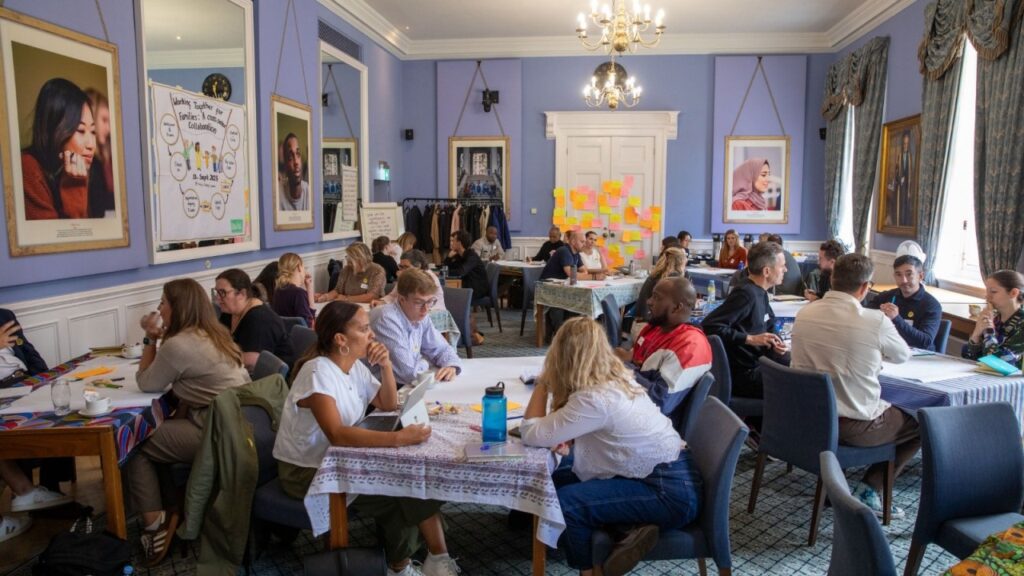
In practice, this work begins with convening organisations and individuals around a clearly framed question. The intention is not to reach immediate conclusions but to create an environment in which participants can explore shared challenges and exchange insight openly.
These early conversations are exploratory by design. They help participants to understand how others are approaching similar issues, surface tensions or points of uncertainty and identify areas where collective learning might be valuable. They also allow us to gauge whether there is appetite for sustained collaboration around a particular theme.
Where interest and energy begin to coalesce, we support the development of smaller communities of practice or action learning sets. These groups bring together a consistent set of participants over time, creating a structured space for reflection, experimentation and mutual support. The diversity of perspective within the group often becomes one of its greatest strengths: practitioners working in different sectors or geographies can bring insights that others have not encountered in their own networks.
As trust develops and inquiry sharpens, collaborative ideas may emerge. At that stage, our role can shift again. Rather than announcing a funding opportunity in advance, we can offer exploratory funding to help test the feasibility of an idea that has appeared through the dialogue. In this way, funding supports a collaboration that has already taken shape, rather than serving as an incentive that attempts to create it. In some instances, collaboration comes first and funding second.
What this means for us as a funder
Adopting this approach has required us to reflect carefully on our own role within the systems we are looking to support. Funding collaboration and shared inquiry places different demands on a funder than supporting clearly defined programmes with predetermined outcomes. It asks us to be attentive to relationships as well as results, and to recognise that meaningful change may take shape over longer periods of time.
This does not reduce the responsibility to steward our resources carefully. Instead, it requires a different form of judgement. When supporting relational work, the signs of progress are not always immediately visible in conventional metrics. Trust developing between partners, new alignments across institutions and the informal exchange of knowledge between practitioners can be difficult to quantify, yet these shifts often create the conditions that allow future initiatives to succeed.
It also requires patience and restraint. Not every community of inquiry will develop into a funded collaboration, and not every promising idea will be ready for support. In many cases, the most responsible role a funder can play is to allow the work to mature at its own pace, offering support where appropriate but resisting the urge to accelerate a process that depends on trust and shared understanding.
We will continue to support programmes and service delivery as we always have. Alongside that work, however, we are increasingly attentive to the relationships and connections that allow promising ideas to spread beyond their immediate setting. Investing in collaboration is not about placing process above impact. It is about recognising that in complex systems, impact is often strengthened, and sometimes made possible, by the relationships that connect people, institutions and communities working towards shared change.